
November 15, 2026
Asking the Right Questions: What Happens When the Buyer Gets Answers First
Rob Gregg
Why I'm writing this
Why would anyone start doing business with someone they know nothing about, on something critical to their operations? Every company that sells anything runs into that question. This is how I've started answering it. I learned it selling pallets, but I don't think it stays in pallets.
I call it paste to vet: the buyer pastes a supplier's prompt into their own AI and vets the supplier before anyone picks up a phone.
I sell pallets for a living. I love what I do, but I hate how I have to do it.
By most industry estimates, more than 90% of goods sit on a pallet at some point. Without them, the economy would come to a standstill. Selling one is a different story. A pallet only matters in two situations: you need them, or they're in the way. Outside of that, nobody thinks about one.
Paying less doesn't matter much to someone who's happy with who they buy from today, or who won't go out to bid until next year. It comes down to timing, and the success rate was low. Then a good friend told me the only thing that moves the needle is pricing. I stopped pitching people on what they needed but didn't want, and started pitching what they wanted. That left one question: how do I get the time of day when my competition's already in there?
It was never really about beating the competition. It's about calling someone for an actual reason, with something of value to offer. I'm not calling to sell you something you don't want. But when you need it, I'm here.
How I got here
My whole journey over the past two years has been one question: how do I bring value to customers? I had to put together a bid for a company with around 30 locations, and I only saw the opportunity as I was struggling to do it. That turned into a bigger question: how do I keep track of all of this? Googling every yard takes an eternity, and a CRM is tedious one record at a time when 400 other things have to happen.
Every step after that went the same way. Once I could find the yards, how do I manage the work? Once the work ran, how do I stand out when everyone offers the same service, from the same yards, in the same area? Once it worked for me, how does it help the customer?
About ten months in, I found out what kind of company this was going to be. Twelve hours before a new customer's first delivery, the yard raised their price. Before I called the customer, I had to decide. Was I the company that says sorry, your price just went up? Or the one that tells the truth: the yard raised their price, I don't want to work with people who work like this, and if you want me to, I'll find you someone else? The customer asked me to keep servicing them until they could get their incumbent back, and I did, at the higher price. They went with somebody else for less. But it is much easier to explain the truth.
I blew a lot of deals along the way, and every failure had me building a tool so I'd be ready next time. Nothing offered what I needed, so I made my own. The goal has only ever been to reduce the number of steps it takes to do business.
I kept asking how to do things better. I don't know if my way is the right way. It's what I'm leaning into. In a world with so much noise that no one can tell the difference between anything, I think a customer experience so different that you're unforgettable is how you stand out.
This is my opinion, and the company I run is betting on it. Some of what follows I'm confident about. Some of it is a guess, and I'll say which is which.
It's about information
Information in the pallet industry is not immediate, but we are working towards it. Today I can drag and drop a 40-location RFP and have communication out to yards in 15 minutes. A year ago, it was a four-day process just to find and email the yards.
Managing their bids was a different problem, and the answer wasn't asking yards to change. I tried that. It's our job to make their process work for us, and the only way I found to do that was to build everything in-house.
The RFP is one example. The same thing works outside our walls. When we make what we know available, like which yards can serve a ZIP code, a buyer's AI can find it and answer for them without a phone call. I think most companies could do the same with what they already know.
What it means for buyers
That is where this idea came from. Once our own information was almost immediate, the question was obvious: why can't the buyer's be? Everyone is already asking AI questions. Sooner or later, they'll ask it to vet suppliers, and it will work with whatever it can find. So I had to figure out how a pallet brokerage could give it something worth finding.
Vetting a supplier used to follow a routine: a cold email or a referral, a request, quotes, a site visit. Each step took days, and both sides took the first call on a gamble.
What plagues this industry is the unknown. Things move fast, prices swing, and it's a market most people never think about. When you can't see what's happening, every request is a guess. A fast answer doesn't make the market predictable. It gives you time to change course while changing course is still cheap.
That's the gap a buyer can close by starting with a question. Do they cover my sites? Can they build what I use? Are they worth a call? The answers come back in minutes, and nothing leaves the buyer's side but a ZIP code.
It isn't perfect yet, but I think this is where buying is headed. It doesn't replace the conversation. It changes where it starts: the buyer already has their answers, so the first call is about the work. It's one more step taken out of doing business. That's what buying can be: the answers come first, and the call happens when it's worth having. If a buyer can do that for pallets, it won't take a genius to ask: can I do this with the other things I buy?
What it means for yards
The same question works from the other side: if a buyer's answers can be immediate, why can't a yard's?
For a yard, the old routine was its own guessing game. A request comes in, you price it, you send it, and often you never hear back. You don't know if the job happened or who got it.
What a yard needs is the same thing a buyer needs: to know. A yard that hears back every time, win or lose, starts to see where the market is moving and can price to it instead of guessing. It still runs its own business, with its own customers and its own number. The information just stops being one-way.
It's the same reduction of steps from the other side. A buyer who gets answers first and a yard that always hears back are one idea, and it only works if both sides get something out of it.
What is changing
Buyers and suppliers have always wanted to know. What's changing is how fast they can. Information keeps getting faster, and expectations will follow. I think there will be a standard for how a supplier presents what it knows, and over time it will be built for an AI to understand first, not a person. When buyers ask their AI first, the supplier whose information it can read and check is the one that gets the call. What it comes down to is providing information in real time.
The first time I watched an AI answer questions about my company, it was on someone else's phone. It found old web pages I thought were gone. And because the person asking didn't know much about pallets, they asked questions I never would have thought to ask. That alone made me clean up what we put out there.
People don't really care about pallets, and a buyer's AI doesn't need our company background. It needs something the buyer can act on. That's why the prompt is built for the buyer, to use when they need it.
What it looks like
On November 15 I ran a test. It was primitive, a proof of concept: I played a buyer with two sites, one in Dallas with three late deliveries, one in Atlanta happy with its supplier. I pasted our prompt into ChatGPT, and it came back with a different answer for each: Pallet Solutions "is worth a call for Dallas, not necessarily Atlanta." It also said both yard counts were unconfirmed. All that left the buyer's side was the ZIP code. No form, no email address, no sales sequence.
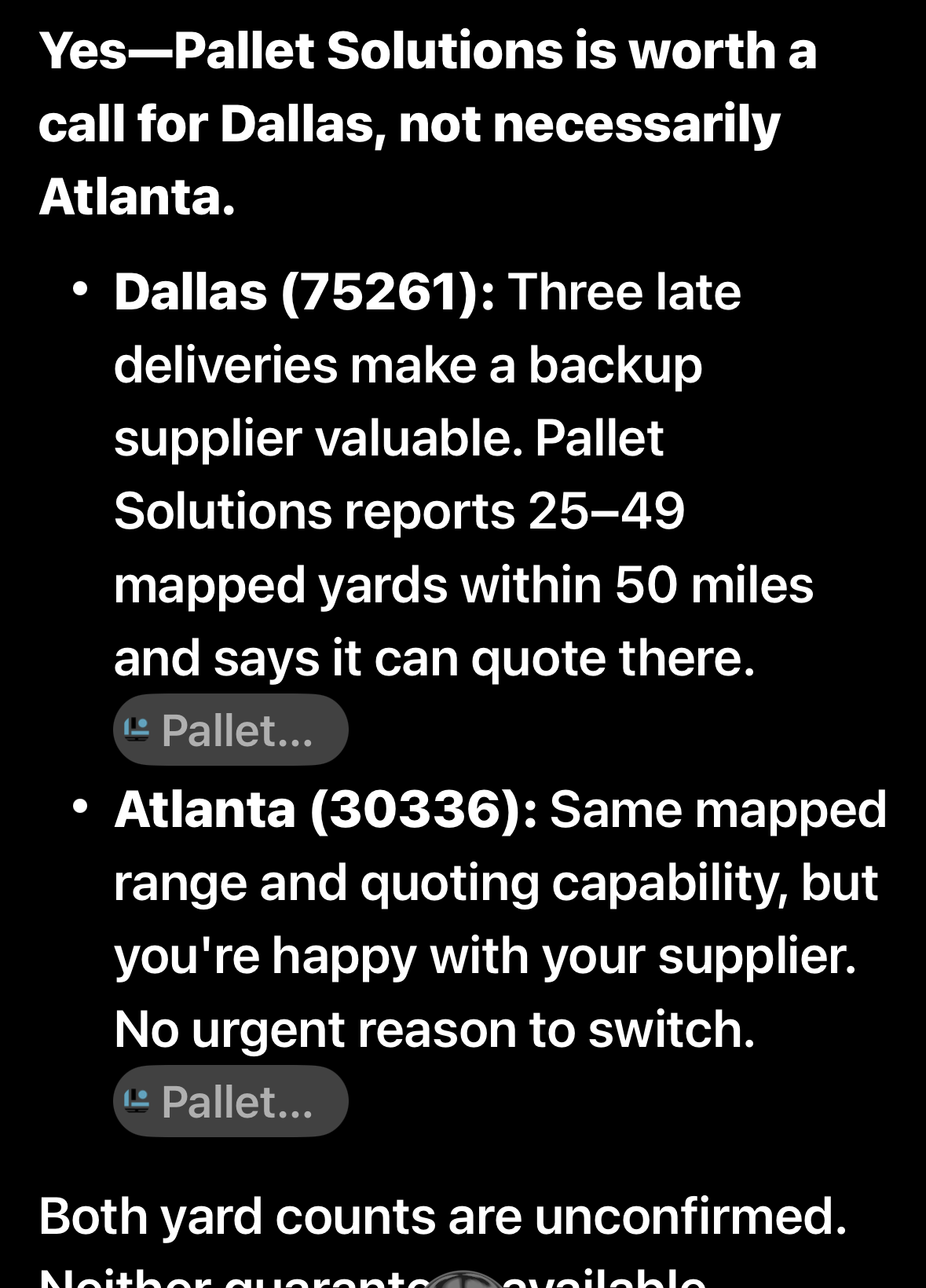
That's paste to vet. Atlanta is happy with its supplier. Does Atlanta need us? Probably not, and I'm fine with that. That's the whole point: by telling the buyer where we weren't worth a call, it showed the prompt will say no to us. That's what makes the yes believable.
What has to be true
Paste to vet only works if four things hold.
- The supplier publishes something true and checkable. If the page says a supplier covers a ZIP, someone can test it.
- The AI says what it couldn't check, and says no when the answer is no. A prompt that only produces yes is an ad.
- Nothing leaves the buyer's side except what the check needs. The vetting happens in the buyer's own tool.
- The buyer still decides. The AI reads. The person calls.
The hardest is the first one. A supplier can't publish live answers if its own information takes days to put together, so the work starts inside the company. A company that wants the business should do the work of being checked, instead of asking the buyer to do the work of checking.
Why I could be wrong
I said I think this is where buying is headed. These are the reasons it might not be.
- "They're just pallets." Pallets are simple, and the people who buy and build them have done fine for decades on a phone call and a handshake. Many may see this as a fix for a problem they don't feel they have.
- Buyers won't trust it. An answer built from a supplier's own prompt is a sales pitch with extra steps, unless the data behind it can be checked.
- The tools aren't reliable yet. On November 13, ChatGPT's web lookup failed on our own page.
- It gets gamed. Companies will write prompts that flatter themselves, the way they once stuffed keywords into web pages.
If I'm wrong, I think it's this one. The idea doesn't fail because it doesn't work. It fails because nobody bothers.
So here's my bet. Within a year, some form of this will be in use, whether it's a prompt like ours or tools that let a buyer's AI connect straight to a supplier's own systems. Any of these would mean I lost it: buyers don't use the prompts even when handed one, AI answers stay too unreliable to act on, the answers turn out wrong when someone checks them, or buyers who vet this way still need the same number of calls.
Back to the first question
Why would anyone start doing business with someone they know nothing about? With paste to vet, they don't have to. The buyer asks, the supplier's own information answers, and the call happens when it's worth having.
The prompt is live at palletsolutionsusa.com/ai-assistant, and every word of it is public. If the answer is no, then we never have to speak to them again. When we do talk, it's for an actual reason.